
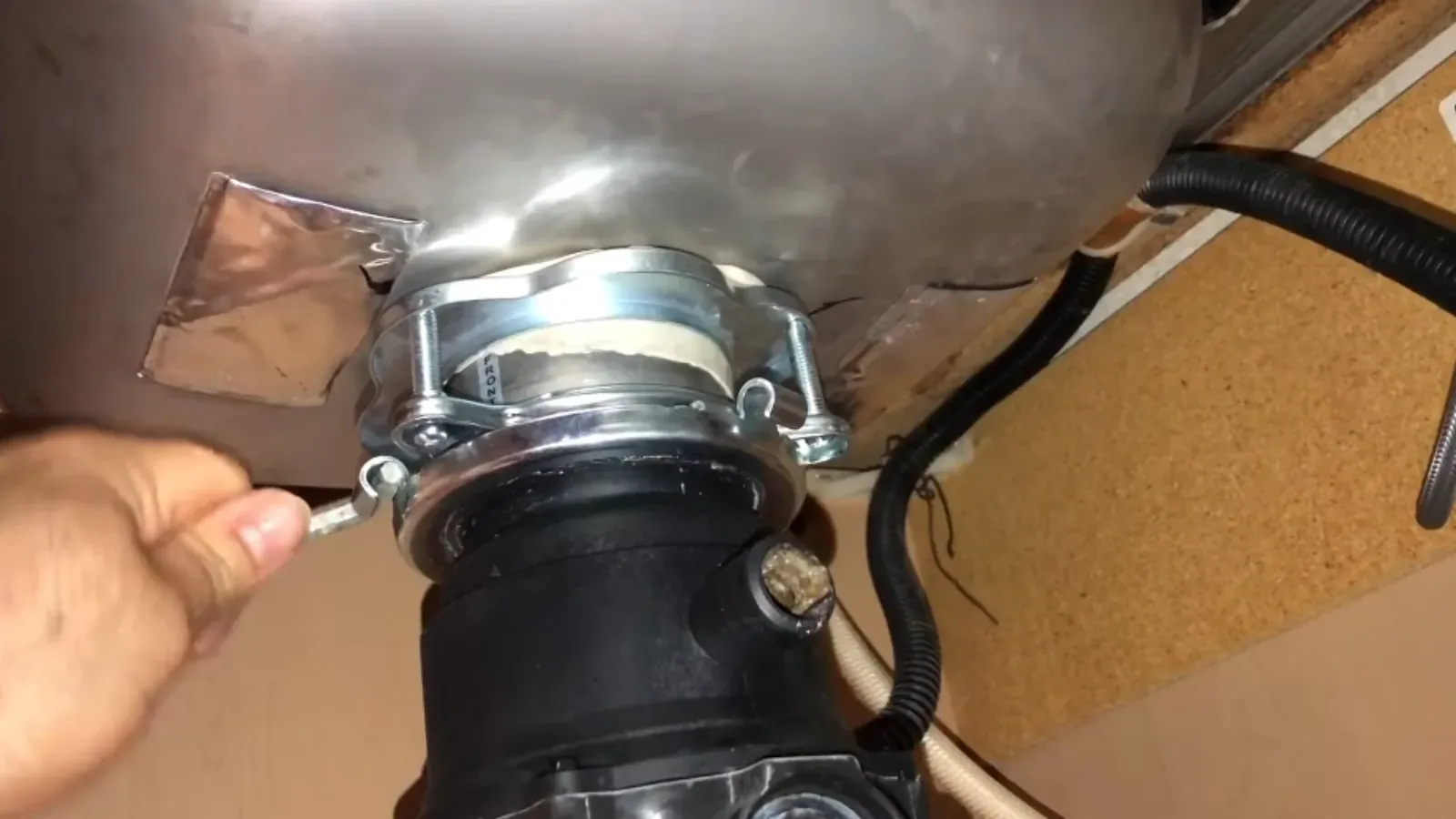
Start with the power, not the blades.
Before anything else, turn off the wall switch and unplug the disposal from the outlet under the sink. If the disposal is hardwired, switch off the breaker. This is the step people skip, and it is the one that prevents injuries.
Once the power is off, shine a flashlight into the sink opening. Look for a spoon, a bottle cap, fruit pits or a pile of fibrous scraps. Use tongs or pliers to remove anything you can see. Do not use your fingers, even with the unit unplugged, because a flywheel can spin when you push on an object.
If you see nothing, move to the next check.
Match the symptom to the likely cause.
This table covers the calls we hear most about.
| What you notice. | Likely cause. | Safe first step. |
|---|---|---|
| Hum with no spinning. | Jammed flywheel. | Power off, turn the flywheel with a hex key from underneath. |
| Nothing happens at all. | Tripped reset or dead outlet. | Press the red reset button on the bottom, test the outlet. |
| Water under the unit. | Failed seal or cracked housing. | Dry everything and watch for the first drip. |
| Sink fills with gray water. | Clog past the disposal. | Do not run the disposal. See drain cleaning. |
| Bad smell. | Food film in the chamber. | Grind ice and citrus peel, rinse with cold water. |
Disposal leaking or sink full of water? Call and a plumber will take over from here.
Call (855) 575-2890Freeing a jammed disposal with a hex key.
Find the socket.
Look at the center of the bottom of the unit for a hex-shaped socket, usually the size supplied in the box.
Turn it back and forth.
Insert the key and work it left and right until it turns a full circle. You are moving the flywheel.
Clear what is stuck.
Look in the chamber again with a flashlight and remove loosened debris with tongs.
Reset and test.
Press the red reset button, restore power and run cold water while you test the switch.
Why a disposal keeps tripping.
If it hums, trips the reset and hums again after you free it, the motor is likely failing. A motor that struggles draws more current than the breaker allows. Pushing the reset repeatedly can overheat it.
Disposals do not last forever. Many run about eight to twelve years under ordinary use. A unit that is past that range and misbehaving is cheaper to replace than to repair, and the replacement comes with a fresh seal and mount.
If you replace one yourself, check the sink flange gasket and the dishwasher inlet knockout. Forgetting to remove the knockout leaves the dishwasher unable to drain.
Leaks: top, side or bottom.
A leak at the top rim means the sink flange seal or mounting ring is loose. A leak from the side often points to the dishwasher hose connection or the drain elbow. A leak from the bottom or through the body means the housing has cracked, and the unit must be replaced.
Dry the area, run water for a minute with the disposal off and watch the first drop form. Tighten what you can. If the leak is in the body, do not wait. Water inside the cabinet rots particleboard quickly.
A plumber can repair a flange seal or replace the unit in a single visit, and our garbage disposal repair service covers both.
What not to put down a disposal.
Most jams and clogs trace back to a short list.
- Grease and cooking oil, which cool and coat the pipe wall..
- Fibrous food such as celery, corn husks and onion skins..
- Pasta, rice and oatmeal, which swell with water..
- Coffee grounds in large amounts, which pack in the trap..
- Bones, fruit pits and anything hard enough to chip the grinding parts..
- Non-food items such as bottle caps, twist ties and produce stickers..
When the real problem is the drain.
Many disposal complaints are drain complaints. If water backs up into the second sink bowl or the dishwasher when you run the disposal, the blockage sits in the kitchen branch line. Replacing the disposal will not fix it.
A cable or a jet removes the grease build-up. If the line clogs every few months, ask about a camera inspection, since a belly or offset in the pipe can catch scraps. Our hydro jetting page explains how a jet cleans the pipe wall.
Replacing or repairing: how to decide.
Repair makes sense for a jam, a reset, a loose mount or a worn seal. Replace when the housing leaks, the motor is weak, the unit is old or the grinding parts are worn smooth.
A new continuous-feed disposal fits most homes. A batch-feed model runs only when a stopper is in place, which some households prefer around children. Horsepower matters less than build quality and sound insulation.
Electrical and plumbing standards.
A disposal is wired under the National Electrical Code (NEC), NFPA 70, and its drain connection follows the trap and drain rules of the International Plumbing Code (IPC). Both point to the same safety habit: cut power at the breaker before any work, and use the manufacturer's hex key socket at the bottom rather than your hand.
Disposals in Chillicothe: sewer or septic.
Most homes inside the city of Chillicothe connect to a municipal sewer, but many homes in the villages and townships around it do not. Ohio assigns plumbing inspection to the county health district under Ohio Administrative Code 1301:3-2-04, so your county health district is the office to ask about septic rules at your address.
If you are on septic, a disposal adds food solids to the tank, and many owners choose not to use one. That is a decision for you and your septic service provider, and it is one of the questions we raise on a visit to Kingston and the other villages around Chillicothe.
Disposal questions from Chillicothe homeowners.
.
It depends on the tank size and how it is maintained. Disposals add solids, which means more frequent pumping. Ask your county health district and your septic service provider before installing one.
.
It is much safer than with the power on, but still avoid it. A flywheel can turn when an object shifts and the cutting parts can be sharp.
Use tongs or pliers instead.
.
The smell often comes from the drain trap or the rubber splash guard, not the grinding chamber. Remove the splash guard and scrub the underside.
.
Often eight to twelve years. Leaks from the body mean replacement regardless of age.
.
Whether disposals can be handled in the evening or on a weekend is confirmed when you call (855) 575-2890, and it is not promised in advance. Describe what is happening and ask what can be arranged. Meanwhile, switch the unit off at the wall and keep hands out of it.