
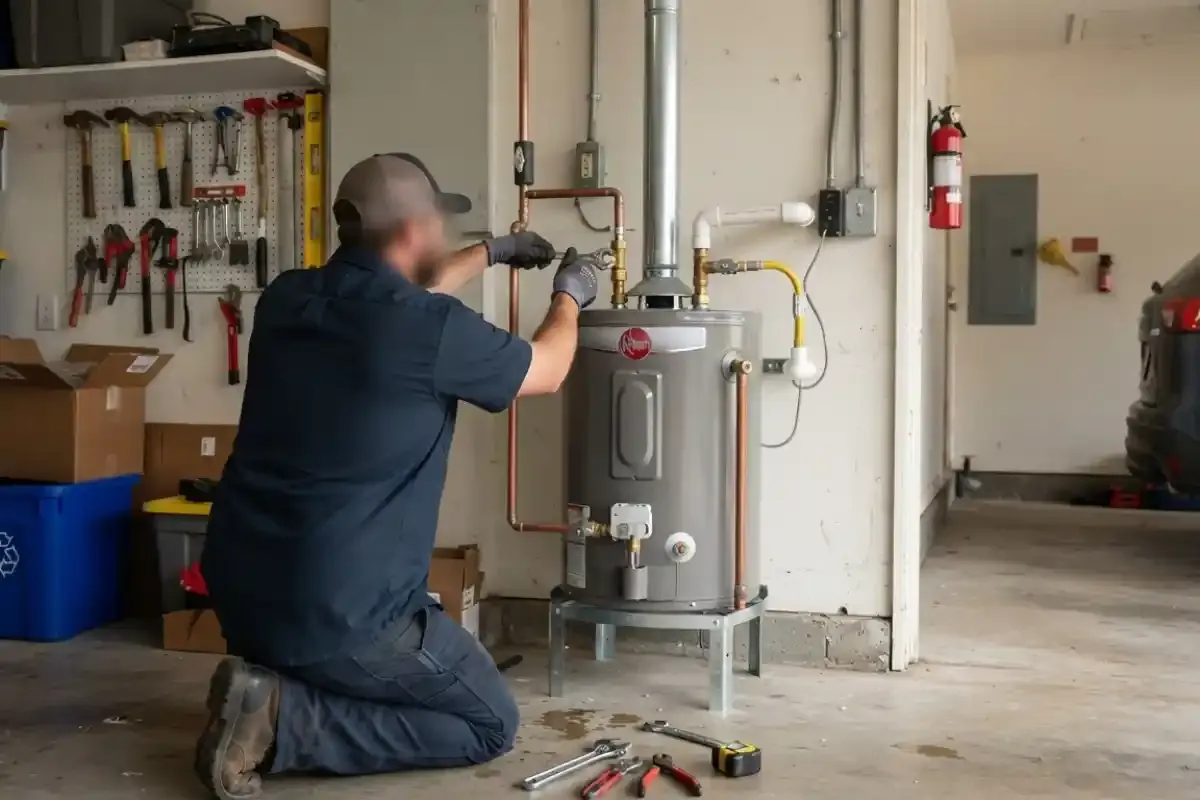
When replacement beats repair.
The clearest case is a leak from the tank body. Steel tanks corrode from the inside, and once water appears at the seam or the base, the lining has failed. Repairs to the surrounding parts will not stop it.
Age is the second case. A unit near 10 or 12 years old with sediment, rumbling and rust-colored water is likely to fail again soon, and putting several hundred dollars into elements or burners on a tired tank rarely pays back.
If the tank is sound and a part is the problem, see water heater repair first. We tell you which one applies after we look.
Choosing the right replacement.
The unit that fits your house depends on fuel, household size and space.
| Option. | Best for. | Things to know. |
|---|---|---|
| Standard gas tank. | Homes with gas service and a working flue. | Fast recovery, needs proper venting and combustion air. |
| Standard electric tank. | Homes without gas, or when the flue is unusable. | Needs a dedicated circuit and a drain pan. |
| Larger or high-recovery tank. | Households of five or more. | Takes more floor space, check ceiling clearance. |
| Tankless unit. | Households that want continuous hot water. | Higher upfront cost, needs venting and gas or power upgrades. |
Tank leaking or hot water gone for good? Call and ask about replacement.
Call (855) 575-2890Sizing the new heater to the household.
A tank that is too small runs out mid-shower. One that is too large wastes fuel keeping extra water hot. We start with the number of people in the house, the number of bathrooms and whether a soaker tub or a large appliance draws heavily at the same time.
For most family homes a 40 to 50 gallon tank is the standard fit, and larger households step up from there. We also check the rated first-hour delivery on the label, since that tells you how the tank behaves under real use.
Venting, gas lines and code details.
A gas heater must vent combustion gases out of the house and draw air in. We inspect the flue pipe, the draft hood or power vent, and the gas shutoff before we install. A flue that has rusted through or runs flat is replaced, not reused.
Every new tank gets a temperature and pressure relief valve piped to the floor or a drain, a drip leg on gas units, a new set of flexible connectors and a thermal expansion tank where a closed system requires it. Ohio plumbing work falls under the state plumbing code. Under Ohio Administrative Code 1301:3-2-04, plumbing inspections are the jurisdiction of the county health district, so permit questions go through them. We can explain what applies to your address.
Ohio licenses plumbing contractors through the Ohio Construction Industry Licensing Board under Chapter 4740 of the Revised Code. Ask any contractor about their license before work begins, including us.
What happens on replacement day.
Shut down and drain.
We close the fuel and water, drain the old tank and disconnect the vent, gas or electrical, and water lines.
Remove and prepare.
The old unit goes out through your stairs or door, and we check the pad, pan and shutoff valves before the new tank goes in.
Install and connect.
We set the new tank, make water and fuel connections, install the relief valve and vent, and add an expansion tank if needed.
Fire up and test.
We fill the tank, purge air, light the burner or power the elements, check for leaks and combustion, and set the thermostat.
Replacement after a flooded basement.
If your basement took on water, the old heater may be damaged even if it looks fine. Electrical parts and gas controls that have been submerged should be replaced.
A heater placed on a stand above the likely water line keeps the next flood from reaching the burner or elements. We use a raised stand on request.
Replacing a heater in a Ross County home.
Water in this area comes from groundwater in the Teays aquifer. Ross County Water Company's 2024 report lists a total hardness of 120 to 140 milligrams per liter for the rural customers it serves, which is moderately hard. Mineral scale builds faster in a new tank when hardness is in that range, so we recommend an annual flush and an anode rod check from the start.
City of Chillicothe customers should check their own utility's current water quality report or test their tap, since a figure for one system does not apply to another.
What affects the cost of a new water heater.
The final number depends on these factors, and we tell you the price before work starts.
- Tank size and efficiency. Larger and higher-efficiency units cost more.
- Fuel and venting. Moving from gas to electric, or repairing a flue, changes the scope.
- Code upgrades. Expansion tanks, drain pans, new shutoffs and a drip leg on gas lines.
- Timing.Ask about any call-out charge before you agree to a visit.
A water heater that failed suddenly and flooded a room may be covered by your homeowners policy for the damage, though usually not for the tank itself. Keep the old unit's data plate photo for your records.
Rules that apply to a replacement.
A replacement has to meet the current Ohio Plumbing Code (based on the IPC) at the connections, including a temperature and pressure relief valve and a safe discharge line. Gas models follow the NFPA 54 National Fuel Gas Code for venting and combustion air. The manufacturer's manual sets clearances and the permit question goes to your county health district.
Water heater replacement questions.
.
Whether water heaters can be handled in the evening or on a weekend is confirmed when you call (855) 575-2890, and it is not promised in advance. Describe what is happening and ask what can be arranged. Meanwhile, turn the unit's gas or power to off and close its cold-water inlet valve.
.
Most standard tank swaps take a few hours. Changing fuel type, moving the heater or rebuilding a flue takes longer.
.
Anode rods protect the tank by corroding in its place. Checking it every few years can extend the life of a tank, but once the tank leaks, the rod is no longer a factor.
.
In Ohio, plumbing inspections are the jurisdiction of the county health district. Whether a permit applies to a like-for-like swap is a local question, and we tell you what applies at your address before we begin.
.
It depends on household use and how much it costs to run gas and venting upgrades. Our tankless page explains the trade-offs.