
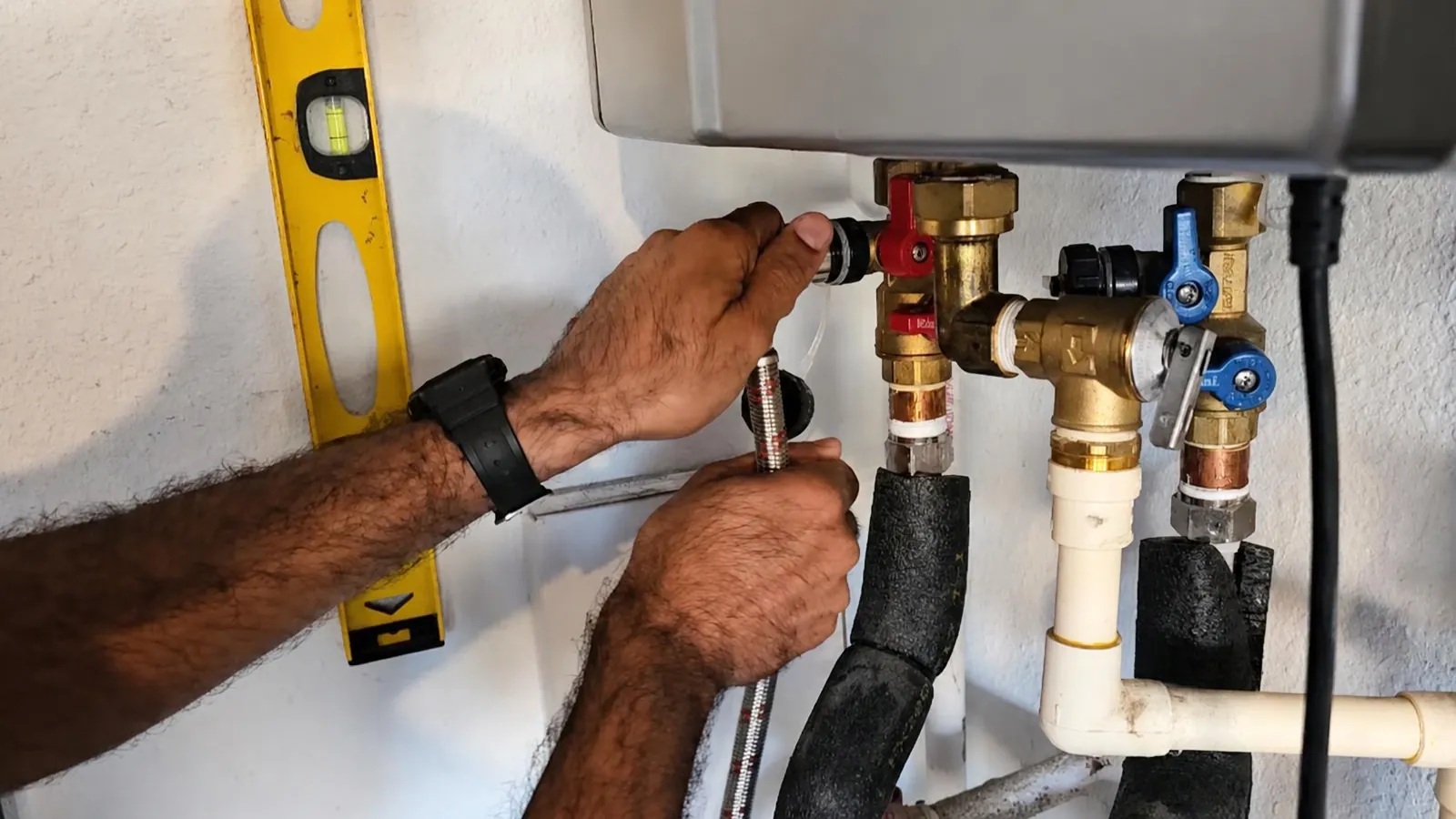
How a tankless water heater works.
When a hot tap opens, a flow sensor tells the unit to fire. A gas burner or electric elements heat the water as it passes through a heat exchanger. When the tap closes, the unit stops.
The benefit is continuous hot water and no standby heat loss. The limit is flow: a unit can only heat so many gallons per minute to a given temperature rise. Running a shower, a dishwasher and a washer at once may exceed a small unit's capacity.
Cold incoming water in a Midwestern winter lowers the flow a unit can heat, so sizing should use the coldest expected inlet temperature.
Tankless or tank: how to decide.
Compare the two on what matters for your house.
| Factor. | Tankless. | Tank. |
|---|---|---|
| Upfront cost. | Higher, including venting and gas upgrades. | Lower. |
| Hot water supply. | Continuous, limited by flow rate. | Limited by tank size, recovers slowly. |
| Space. | Wall-mounted, frees floor space. | Needs floor space. |
| Maintenance. | Annual flush or descale required. | Occasional flush, anode check. |
| Failure mode. | Error codes and scale buildup. | Tank leak. |
If the tank in your basement has failed, our replacement page covers the like-for-like option.
Thinking about tankless? Call and we will walk through venting, gas and power before quoting.
Call (855) 575-2890Venting, gas and electrical requirements.
Gas tankless units need a larger gas line than a tank, and they vent with PVC, CPVC or stainless pipe, depending on the model. Condensing units have very hot flue gas cooled almost to the point of condensation, so their vent is a sealed plastic pipe through the wall or roof. The vent route has to slope correctly and drain condensate.
Electric tankless units draw high amperage, often needing heavy circuits and a panel upgrade. We check your panel before we recommend one.
The vent, gas line and electrical work are the details that decide the job cost, so we survey them first.
Flush and descale: the service tankless units need.
Scale is the main cause of tankless problems.
Isolate the unit.
We close the water and gas, and attach hoses to the service valves.
Circulate descaler.
A pump circulates a mild acid solution, usually food-grade vinegar or a manufacturer-approved descaler, through the heat exchanger.
Rinse and clean filters.
We flush with clean water and clean the inlet screen.
Test and record.
We check error codes, temperature rise and flow, and note the date for your next service.
Annual descaling is common where water is moderately hard. Ross County Water Company reports 120 to 140 milligrams per liter of hardness for its customers, and the City of Chillicothe's customers should test their tap. Over time, scale narrows the heat exchanger and triggers error codes.
Common error codes and repairs.
Ignition failures, flame sensor faults, flow sensor problems and overheat shutdowns are the common ones. Many trace back to scale, a dirty inlet filter or a vent that has partly blocked.
We read the code, check the supply and test the parts before ordering. For repair, see water heater repair for the general process.
Hybrid and electric options.
A hybrid or heat pump water heater uses electricity to move heat from the surrounding air into a tank. It uses less energy than a standard electric tank, but it needs space, a drain for condensate and a location where cooler air is acceptable.
It is a different animal from tankless and suits some basements. We compare it with tankless and standard tanks if you ask.
Tankless in Chillicothe homes.
Many homes in Chillicothe have basements that are cool in winter, and incoming water can be quite cold. That drives sizing: a unit that handles a household in July may struggle in January. We size for winter.
If your home is on a well or on rural water outside the city, test the water for hardness and iron first. Hard or iron-rich water shortens a tankless unit's life without a softener. See our water softener and filtration page.
What affects tankless pricing.
We quote the whole job, not just the unit.
- Unit capacity and brand. Larger units and condensing models cost more.
- Venting and gas line. Long vents and upgraded gas piping add cost.
- Electrical or panel work. Electric units may need new circuits.
- Water treatment. A softener or filter may be advised.
Some utilities and manufacturers offer rebates on efficient water heaters. Ask your gas or electric provider before you buy.
Standards for a tankless unit.
A tankless gas unit follows the manufacturer's venting and gas sizing tables and the NFPA 54 National Fuel Gas Code. Many models need a larger gas line than a tank heater, and the Ohio Plumbing Code, built on the International Plumbing Code (IPC), covers the water side. Sizing the line is the step most often missed. If you live in a larger west-side subdivision such as Yaples Orchard, our neighborhood page lists the questions worth asking.
Tankless water heater questions answered.
.
It can be for households that value continuous hot water and floor space, but the extra install cost takes years to recoup in energy savings. We lay out both so you can decide.
.
Common causes are scale, a blocked filter, low gas pressure or a vent problem. Read the code from the display and tell us when you call.
.
Manufacturers commonly recommend yearly, and more often in hard water.
We note the date and set a reminder.
.
Often not. Tankless units need higher gas flow than most tank units. We measure the line before we quote.
.
We repair when we can. When the heat exchanger has failed, replacement is usually more sensible.