
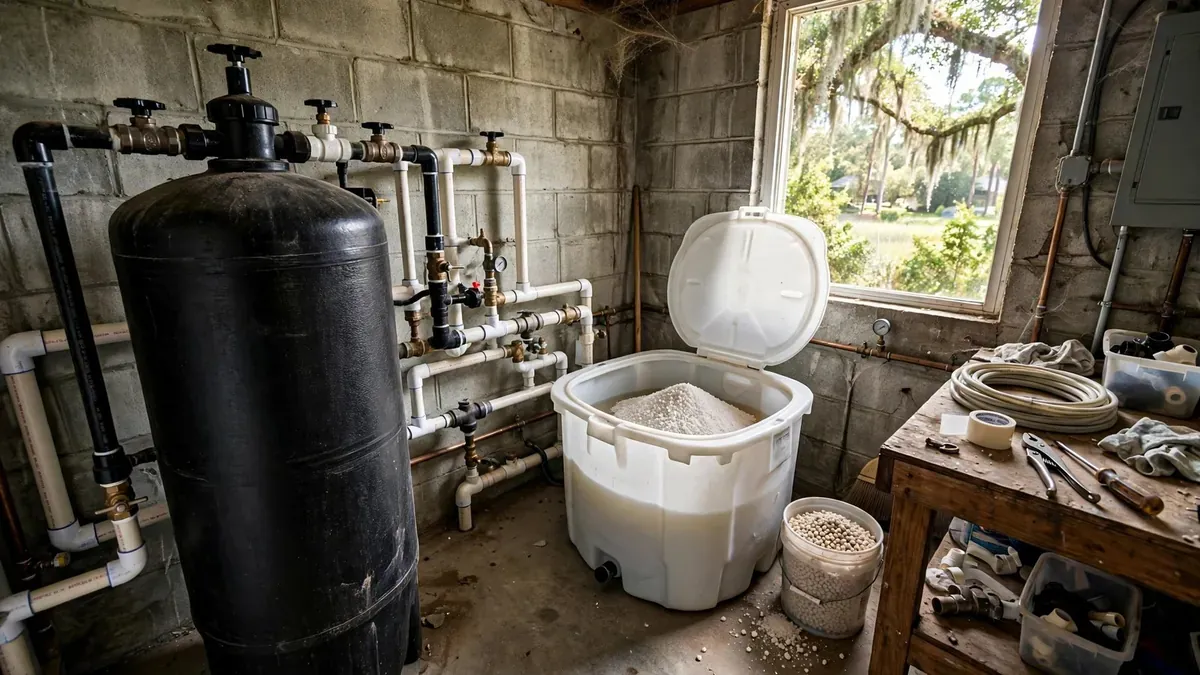
Five checks in order.
Test the water.
Test hardness at a tap that comes after the softener. Compare it with the water before the unit using a test strip or kit.
Check the salt.
Lift the lid. The salt should be at least a third full, above the water line.
Look for a salt bridge.
Poke the salt with a broom handle. If it is a hard crust with a hollow space beneath, break it up.
Check the bypass valve.
Make sure the bypass is in the service position and not left open after a repair.
Watch a regeneration.
Start a manual regeneration and listen for water moving, brine draw and drain flow.
Symptoms and likely causes.
Match what you see to the part.
| Symptom. | Likely cause. | What fixes it. |
|---|---|---|
| Hard water, tank full of salt. | Salt bridge or mush. | Break the bridge, clean the tank. |
| No brine in the tank. | Clogged injector or brine line. | Clean the injector and screen. |
| Runs out of soft water quickly. | Settings too low or resin wearing out. | Reset hardness, test the resin. |
| Constantly draining. | Stuck or worn control valve seals. | Rebuild the valve. |
| Rusty or orange stains. | Iron fouling the resin. | Resin cleaner, or pre-filter. |
| Unit does nothing. | No power or a failed controller. | Check the plug, replace the board. |
Scale back on your faucets? Call and we will test the water at the unit.
Call (855) 575-2890Salt bridges and mush.
A salt bridge forms when humidity or the wrong salt causes a crust at the top of the tank. Underneath, the salt dissolves and leaves a gap, so no brine is made. The unit looks full but is not working.
Mush is a sludge of salt and impurities at the bottom that clogs the brine line. Scoop out the salt, empty the tank, rinse it and refill with fresh salt.
Use the salt type your manufacturer recommends. Pellets resist bridging better than block salt.
Settings that drift.
A softener needs the correct hardness setting to know when to regenerate. If the setting is too low, the resin runs out before the next cycle and hard water gets through. If your water changed, or the settings were reset after a power outage, adjust them.
Set the hardness from a test, not a guess. Hardness varies by system and over time. Check it once a year.
Resin age and replacement.
Resin beads exchange hardness minerals for sodium. Over many years, chlorine in the supply and iron wear them down. A softener 10 to 15 years old that cannot hold a charge may need new resin or a new unit.
Replacing resin is a service-tech job. The cost is compared against a new unit. We give you a clear comparison.
When to call a plumber.
Call when you find a leak at the valve, when the unit runs continuously, when the controller shows an error or when you are unsure about the bypass and drain lines.
A plumber also checks the drain line for an air gap and the overflow for correct routing, which prevents wastewater from backing up. Our water softener and filtration page covers repair and installation.
Keeping a softener healthy for years.
A softener repays a little attention. Check the salt monthly, clean the brine tank once a year and use a resin cleaner if your water carries iron.
Run a manual regeneration after you adjust settings, then test the water again at a tap to confirm. Write the test date and result on a card next to the unit.
If your household grows or shrinks, update the settings. A family of two and a family of six use very different amounts of softened water.
Bypass valves and what they are for.
The bypass valve lets water skip the softener while you service it. Many people leave it in bypass after a repair and wonder why the water is hard. Confirm it is in service position before you call for help.
What a service call includes.
A technician starts with a hardness test before and after the unit. Then they check the salt, the brine line, the injector and screen, the control valve and the drain line, and run a regeneration while watching each stage.
You should leave the visit knowing which part failed, what it costs to fix and whether the resin bed is healthy. If the unit is near the end of its life, a good technician tells you so and shows the comparison with a new one.
Choosing salt and avoiding bridges.
Pellet salt dissolves cleanly and resists bridging better than block salt in most units. Fill to no more than a few inches above the water line and break any crust you find. Avoid mixing salt types, and clean out the tank once a year to remove sludge before it reaches the brine line.
Standards for softeners.
Residential softeners are tested to NSF/ANSI 44, which covers cation exchange units, including their capacity and salt efficiency claims. Check the label for it. The Ross County Water Company reports about 7 to 8 grains per gallon of hardness, so a test of your own tap tells you how much work the softener actually has.
Setting a softener for Ross County water.
The Ross County Water Company's 2024 report lists total hardness of 120 to 140 milligrams per liter, which it also gives as 7 to 8 grains per gallon. That is the figure to compare against if you are served by the company, including homes in and around Kingston. Set your softener's hardness from a test at your tap and use the report as a cross-check.
City of Chillicothe customers draw groundwater too, but hardness is a property of each system, so check the city's water quality report or test your tap before setting a number. Iron below 0.10 milligrams per liter in the company's report means iron fouling is less likely to be your problem than a worn resin bed or a bridged salt tank.
Water softener questions from Chillicothe homeowners.
.
The company's 2024 report lists total hardness of 120 to 140 milligrams per liter, about 7 to 8 grains per gallon. City customers should check their own report.
.
At least a third full, and above the water line. Check monthly.
Do not overfill past the manufacturer's mark.
.
A stuck valve, a setting that is too high or a leak in the brine system. A technician can measure salt per cycle.
.
Softened water contains added sodium. People on sodium-restricted diets should ask their doctor, and may prefer an unsoftened drinking tap.
.
Yes. Call (855) 575-2890.