
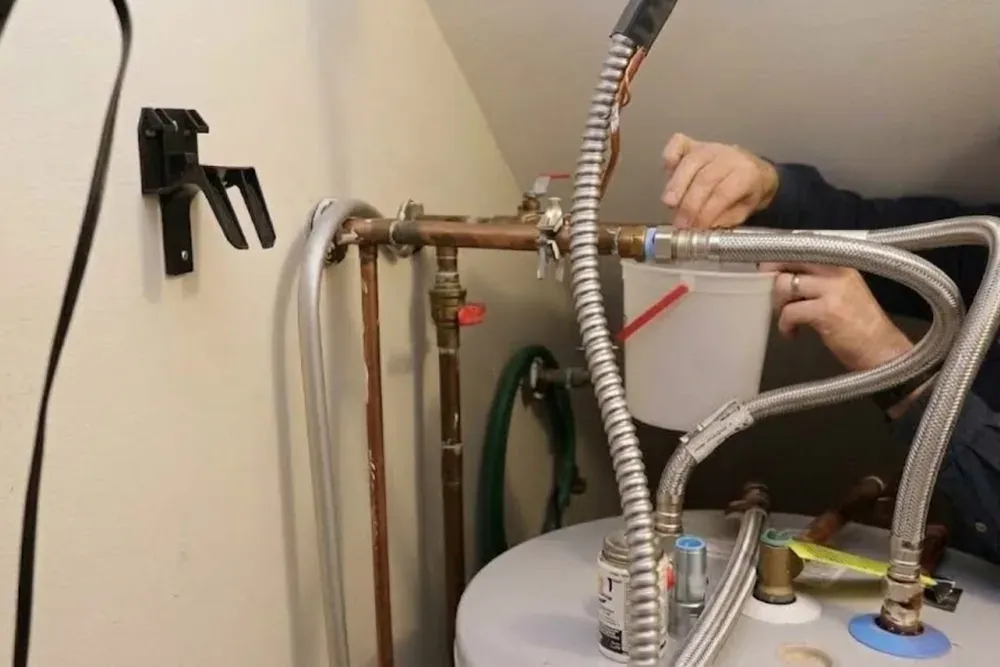
What a thermocouple actually does.
A thermocouple is a small rod of two dissimilar metals that sits in the pilot flame. Heat from the pilot makes it produce a tiny electrical current. That current holds the gas valve open.
If the pilot goes out, the current stops, and the valve closes and cuts off the gas. It is a safety device. A weak or worn thermocouple fails to hold the valve open even when the pilot is lit, so the pilot dies as soon as you release the button.
That symptom, a pilot that lights but will not stay lit, is the classic sign.
Signs the thermocouple is the problem.
These point toward the part rather than the whole unit.
- The pilot lights while you hold the button and goes out when you release it..
- The pilot burns weak or has a yellow, flickering tip..
- The tip of the thermocouple is black with soot or visibly bent..
- The heater has run for years with no pilot trouble, then suddenly fails..
- There is a smell of gas. If so, stop. See the safety section below..
Pilot keeps going out? Call and a plumber can test the whole assembly in one visit.
Call (855) 575-2890Safety first: gas smells and who to call.
If you smell gas near the heater, do not touch light switches or try to relight anything. Leave the house, then call 911 or your gas supplier from outside. Once the gas is shut off and checked, call a plumber.
Your gas supplier's name is on your monthly bill. Chillicothe-area homes are served by different suppliers depending on the street, so we point you to your bill rather than guess.
Pilot problems: thermocouple or something else.
Several parts produce the same symptom.
| Part. | How it fails. | How to tell. |
|---|---|---|
| Thermocouple. | Weak current, pilot drops when button is released. | Pilot is lit with a good flame, still dies. |
| Pilot tube or orifice. | Clogged with dust and debris. | Weak yellow flame. |
| Gas control valve. | Valve will not stay open or leaks internally. | New thermocouple does not help. |
| Draft or flue problem. | Wind or a blocked flue blows the pilot out. | Pilot dies when a door slams or the furnace starts. |
| Thermopile (some models). | Weak millivolt output. | Heater has a spark or electronic ignition. |
How the replacement works.
Turn the control to off and let it cool.
Close the gas control knob and wait several minutes. Shut the gas at the line if you can.
Open the burner access door.
Remove the access cover to reach the pilot assembly and the control valve.
Unscrew the old thermocouple.
It connects to the control valve with a small nut. The other end sits in a bracket at the pilot flame.
Fit the new part.
Insert it into the same bracket so the tip sits in the flame. Tighten the nut snugly, not hard.
Relight and check.
Follow the label on the heater to relight, then watch the pilot for several minutes and test the burner.
Where a plumber should take over.
Replacing a thermocouple is a modest repair on a heater in good condition. It becomes a plumber's job when the unit is old, the burner is dirty, the flue draws poorly or the gas valve is suspect. Those problems are not obvious from the outside.
A plumber also checks combustion. If the burner flame is yellow, if soot is building on the bottom of the tank or if the flue is warm only at the draft hood, the heater is not breathing right. Our water heater repair visit includes those checks.
If the tank itself is old and rusted at the base, a new thermocouple only buys time. See water heater replacement for the next step.
What a thermocouple costs.
The part is inexpensive at a hardware or plumbing supply counter. What costs more is the visit, which covers the diagnosis, the combustion check and cleanup of soot or rust.
We give a clear price before work begins, and we say honestly when a part this small is not the real cause.
Keeping the pilot area clean.
Dust and lint collect around the pilot and the burner, especially in basements that share space with a dryer. A dirty pilot burns weak and heats the thermocouple poorly.
A plumber cleans the burner area during a visit. Between visits, keep the area around the heater clear of stored items and never place flammable liquids nearby.
Standards for gas water heaters.
Gas storage water heaters are built to ANSI Z21.10.1, and the gas piping and venting around them follow the NFPA 54 National Fuel Gas Code. The thermocouple is a listed safety part, so use the exact replacement the manufacturer specifies. If you smell gas, leave the house and call 911 or your gas supplier.
Gas water heaters in Ross County basements.
Water in the Chillicothe area comes from groundwater. The Ross County Water Company's 2024 report lists total hardness of 120 to 140 milligrams per liter for its system, about 7 to 8 grains per gallon. That kind of water builds sediment on the tank bottom, and sediment under a gas burner overheats the tank steel and the extra heat deposits soot around the pilot area.
If your pilot trouble comes with a rumbling tank, flush the tank or ask a plumber to. Customers of the City of Chillicothe should check their own water quality report, since a figure for one system does not apply to another. Plumbing work in Ohio is licensed under Chapter 4740 of the Revised Code, so ask any contractor who works on your heater about their license.
Thermocouple questions from Chillicothe homeowners.
.
A thermocouple problem shows as a pilot that will not stay lit. A failing tank shows as water around the base, rust-colored hot water or a rumbling noise. If you have both, the tank age decides.
.
Universal parts exist and are common. Match the length and the connector to your valve.
Using the manufacturer's part is the safest choice.
.
A draft problem. A blocked or short flue lets wind back down. A plumber can check the draw.
.
If the heater is in good condition and there is no gas smell, the label on the heater explains the process. If you smell gas or the pilot repeatedly fails, call.
.
Whether gas water heaters can be handled in the evening or on a weekend is confirmed when you call (855) 575-2890, and it is not promised in advance. Describe what is happening and ask what can be arranged. Meanwhile, turn the unit's gas or power to off and close its cold-water inlet valve.