
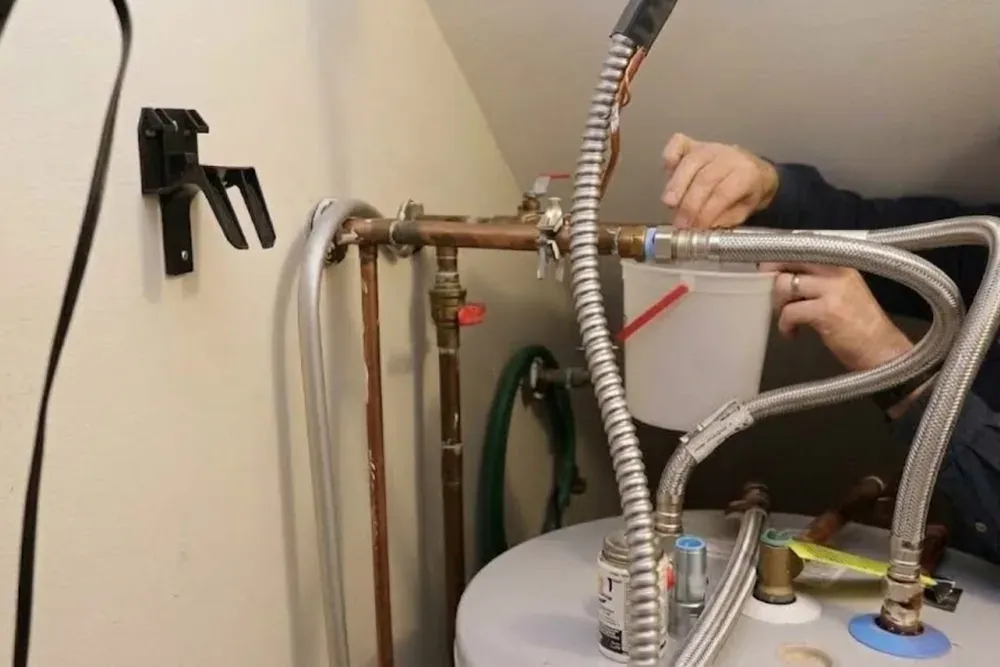
Which gaskets a water heater has.
Different models have different seals.
| Gasket. | Where it is. | Fails by. |
|---|---|---|
| Element gasket (electric). | Under the access panel, around each heating element. | Hardening, scale and overtightening. |
| Flange gasket (some models). | Around the lower or side access port. | Aging and mineral buildup. |
| Union or connector washers. | At the hot and cold connections. | Compression and corrosion. |
| Drain valve washer. | Inside the drain valve. | Debris and wear. |
| Relief valve seat. | Inside the temperature and pressure relief valve. | Debris or high pressure. |
Signs of a gasket leak rather than a tank leak.
These clues point toward a repair.
- Water appears at a specific access panel or fitting, not from the seam of the tank..
- The drip is slow and steady, not a flow..
- The tank is under ten years old and the water is clear..
- Insulation under an electric unit's access panel is wet and the top of the element is damp..
- The leak stops when the water supply is shut off and starts again when it is open..
Leak near the element or a fitting? Call and we will tell you if the tank is sound.
Call (855) 575-2890How an electric element gasket is replaced.
Turn off power and water.
Switch off the breaker, and close the cold supply. Confirm with a tester that the power is dead.
Drain below the element.
Attach a hose to the drain valve and drain enough of the tank to bring the water level below the element.
Remove the element.
Take off the access cover and insulation, disconnect the wires and unscrew the element with an element wrench.
Replace the gasket.
Clean the seat, fit a new gasket and install the element hand tight plus a quarter turn. Do not overtighten.
Refill and check.
Refill the tank fully with a hot tap open to purge air, then restore power and check for drips.
A caution about restoring power.
Never turn the breaker back on until the tank is full. An electric element energized without water burns out in seconds. Refilling with a hot tap open lets air escape.
If you are not comfortable working with electricity or draining a tank, call a plumber. Our water heater repair page lists the checks we do before and after.
Union and connector leaks.
Water at the top of the tank is often a failed washer or a corroded fitting. Tightening a nut may help for a day. A better fix is a new flexible connector with proper washers.
Dielectric unions or nipples that have corroded together need replacement. Dissimilar metals in contact cause galvanic corrosion in water heater connections.
Gas units: fewer gaskets, same logic.
Gas water heaters do not have element gaskets, but they have a drain valve, connectors and a relief valve. A leak at the bottom may come from the drain valve or from the tank. A flame arrestor and a burner chamber that are wet need a technician.
If water appears under a gas heater, turn off the gas before investigating.
When a gasket repair is not worth it.
If the tank is more than ten to twelve years old, or the leak is from the seam or the bottom, a gasket will not help. Replace the unit. See water heater replacement.
If the tank has rust around the access panel, a new gasket may seat poorly. Look at the metal before you buy parts.
Buying the right gasket.
Take the old gasket or the element with you to the supply counter. Element gaskets come in different sizes and thicknesses, and a close match is not enough.
Replace the gasket every time you remove the element. Reusing an old one invites a leak that you will find after the tank has refilled and the walls are closed up.
Testing after the repair.
After refilling, watch the repair for an hour. Check again the next morning. A slow weep that shows up at night is easier to catch with a dry paper towel placed under the element.
If it still leaks, the seat on the tank may be corroded, which means the tank is nearing the end of its life.
Why electric elements fail with their gaskets.
Elements and gaskets often fail together because both are hurt by scale. Scale insulates the element, makes it run hotter and bakes the rubber around the seat.
If you replace a gasket on a unit that is more than a few years old, ask the plumber to test the element at the same time. Replacing both in one visit saves a second drain and refill.
Standards behind the parts.
Gas storage heaters are built to ANSI Z21.10.1 and electric storage heaters to UL 174, so replacement gaskets and elements should match the manufacturer's listed part for your model. A generic part may fit and still fail early, which is the reason to check the model plate first.
Scale and gaskets in Ross County water.
The Ross County Water Company's 2024 report lists total hardness of 120 to 140 milligrams per liter for its groundwater supply, and low iron, below 0.10 milligrams per liter. Moderate hardness leaves scale around element seats and gasket faces, which can keep a new gasket from sealing and shortens the life of the element.
When we replace a gasket we clean the seat and, if the water is hard, recommend an annual flush. City of Chillicothe customers should look at their own water quality report or test their tap. Plumbing work in Ohio is licensed under Chapter 4740 of the Revised Code. If you are in the villages around the city, such as Kingston, tell us your water source when you call.
Gasket questions from Chillicothe homeowners.
.
It can leak steadily enough to wet a floor. The leak is usually slow, but a failed gasket on an electric unit may release more water if it is badly seated.
.
Not always. If the element tests good with a meter, reuse it. Scale-coated or burned elements should be replaced.
A technician tests it.
.
Hand tight plus a quarter turn is typical. Follow the manufacturer.
.
No. The water level must be below the element or the water will flow out.
.
Yes. Call (855) 575-2890.