
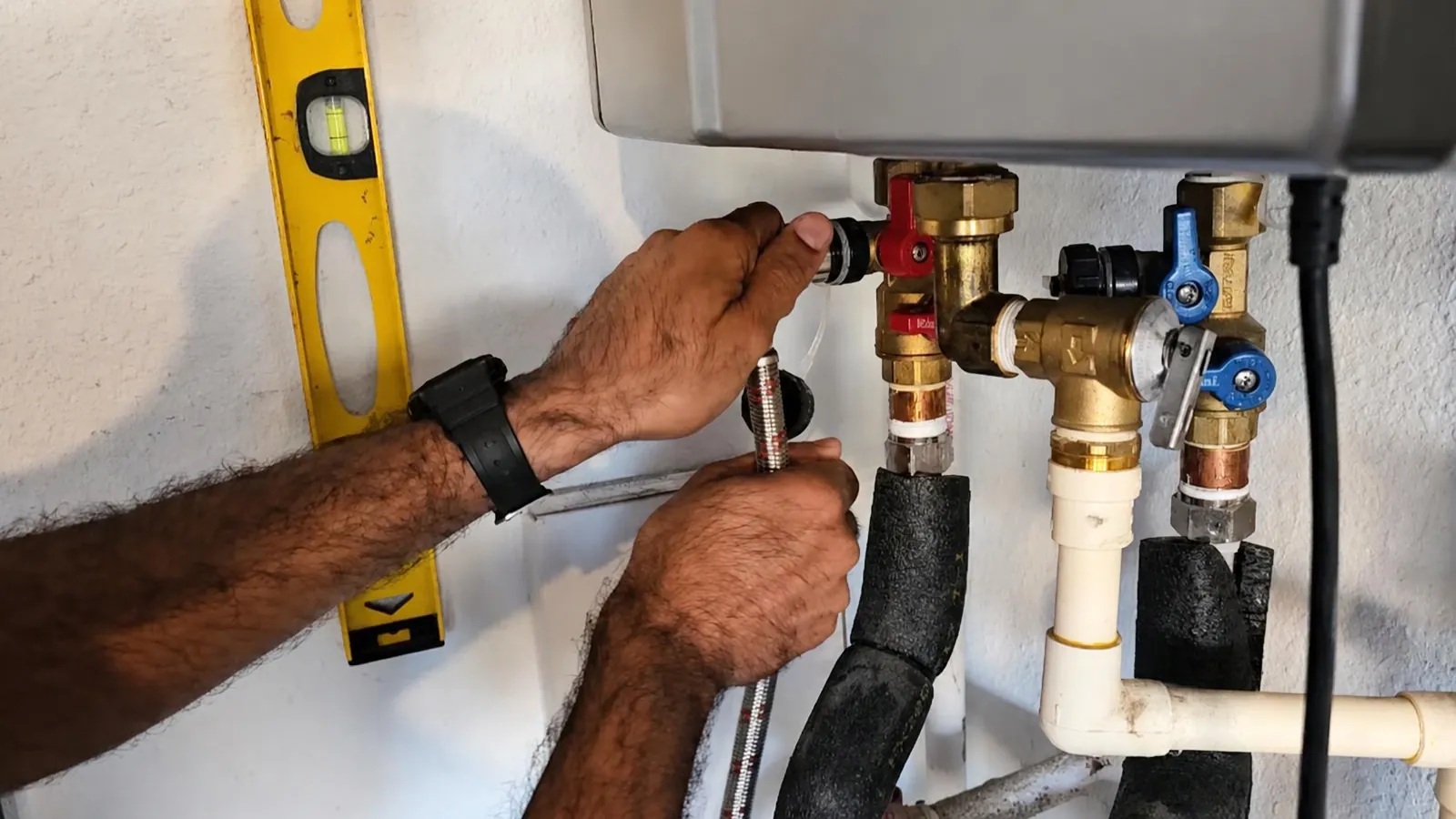
Condensing and non-condensing units.
The two types vent differently.
| Type. | Flue gas temperature. | Typical vent material. |
|---|---|---|
| Condensing (high efficiency). | Cool, near condensation. | PVC, CPVC or polypropylene, as the manual lists. |
| Non-condensing. | Hot. | Stainless steel, such as Type AL29-4C. |
Never substitute the vent material. The manufacturer's installation manual lists the approved materials by model.
Why condensing units can use plastic.
A condensing tankless heater has a second heat exchanger that pulls extra heat from the exhaust. The exhaust leaves cool, around the temperature of a warm shower, and carries condensate. Plastic withstands those conditions.
The condensate is mildly acidic and must drain. It runs through a trap and a neutralizer to a floor drain or a condensate pump. Many installation problems come from a condensate line that is not sloped or trapped correctly.
Planning a tankless install? Call and we will check the vent path before you buy.
Call (855) 575-2890Slope, length and elbows.
The vent pipe slopes back toward the unit, usually a quarter inch per foot, so that condensate runs back to the drain rather than collecting in the pipe. A sag in the vent run can trap water and block the flow.
Every manufacturer limits the total equivalent length of vent pipe, with each elbow counting as extra feet. Run the numbers for your layout. A vent that is too long causes error codes and poor performance.
Planning the vent path.
Pick the termination.
Choose a wall or roof location that meets the manual's clearances from windows, doors, air intakes and grade.
Measure the run.
Measure the vent and air intake pipes, count elbows and add equivalent lengths.
Check the materials.
Match pipe, cement and primer to the manual. Some require specific brands or listed pipe.
Support and seal.
Support the pipe at the spacing given in the manual and seal every joint properly.
Plan the condensate.
Route the condensate to a drain with the correct trap and neutralizer.
Direct vent and combustion air.
Many tankless units are direct vent, which means two pipes: one that exhausts and one that brings in fresh air for combustion. Both must terminate where they cannot be blocked by snow, leaves or a drift.
In a basement, make sure the intake terminates outside. A unit that draws combustion air from inside a tight basement can struggle.
Common vent mistakes we see.
These show up on inspections and call-backs.
- Using schedule 40 pipe when the manual requires a specific listed material..
- Cementing the vent with the wrong cement for the pipe type..
- Letting the vent run level or sag, so condensate pools..
- Ignoring the maximum equivalent length..
- Terminating too close to a window, a door or a gas meter..
- Missing support brackets, so a long run droops..
Who should do the work.
A tankless install touches gas, venting and water at once. Mistakes can lead to carbon monoxide in the house. We install tankless units with a combustion check at the end and leave you the documents. See our tankless water heater page for what the job includes.
Why the manual is the rule.
Manufacturers test each unit with specific vent materials, lengths and terminations, and the listing for the unit depends on following those details. A vent that works in practice but deviates from the manual can void the warranty and raise a safety question.
Keep the manual and the installation record with the heater. If you sell the house, the buyer's inspector may ask for them.
Carbon monoxide detectors near a gas appliance.
Any home with a gas appliance should have working carbon monoxide detectors on each level and near sleeping areas. Test them monthly and replace them as the maker directs.
Detectors are not a substitute for a correct vent, but they are the last line of defense when something goes wrong.
Replacing a tank with a tankless unit.
When a house changes from a tank to a tankless unit, the old chimney flue is usually no longer the vent. The new vent goes out a wall or roof, and the old flue may need to be capped or lined so it does not leak.
Plan the route before you buy. A basement where the wall is below grade, or one with a finished ceiling, can make the vent run hard to hide.
Inspecting an existing vent.
If you already have a tankless heater, look at the vent once a year. Check joints for gaps, support brackets for sag and the termination for nests, snow or debris. Look for white mineral crust, which can signal a condensate leak. A short inspection catches problems before the unit shuts down.
Which rules decide the vent.
The vent material is set by the unit's manufacturer and the NFPA 54 National Fuel Gas Code, not by what a supply house happens to stock. Gas tankless units are built to ANSI Z21.10.3. Use only the pipe, length and fittings listed in the manual, and ask the installer to show you the page.
Who regulates plumbing work in Ohio.
Contractor licensing in Ohio sits with the Ohio Construction Industry Licensing Board (Revised Code Chapter 4740). Inspection is a separate office: Ohio Administrative Code 1301:3-2-04 gives plumbing inspection to the county health district, and certified municipal building departments may employ plumbing inspectors.
The City of Chillicothe's building department states that it enforces the city's zoning, flood plain and residential building codes. We do not guess on gas and vent rules from memory. For a tankless install in Chillicothe or a village such as Kingston, we confirm which offices apply to your address, follow the manufacturer's manual for the vent and leave the paperwork with you.
Tankless vent questions from Chillicothe homeowners.
.
Only if the manufacturer lists PVC for your model, which is the case for many condensing units. Non-condensing units need stainless steel.
.
Each model has a maximum equivalent length listed in the manual. Elbows add to it.
A plumber can calculate it for your layout.
.
Not necessarily. Many go through a side wall. The manual lists the clearances.
.
To a drain, through a trap and often a neutralizer. A condensate pump is used when no drain is close.
.
Yes. Call (855) 575-2890 to schedule a survey.