
What a sewer camera inspection is.
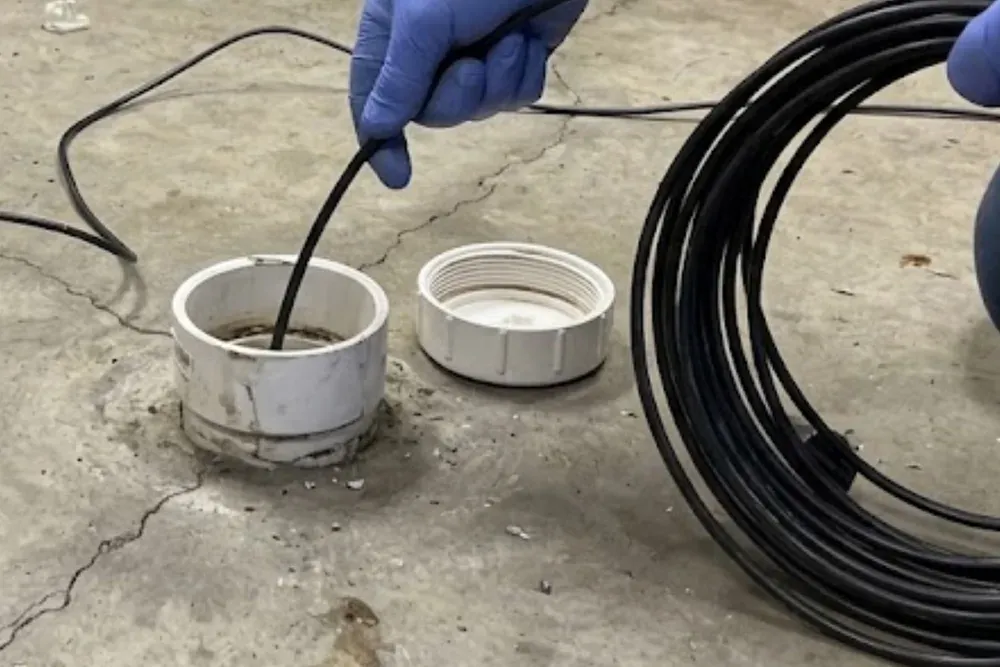
A waterproof camera on a flexible push rod travels through the line from a cleanout or a pulled toilet. A transmitter in the camera head lets us locate its position and depth from above ground with a receiver.
The monitor shows pipe material, joints, cracks, roots, offsets, sags and debris. We mark the location of anything of concern on the surface so you can see where it is relative to the house, driveway and trees.
What the camera can show, and what it means.
Each finding calls for a different response.
| What we see. | What it means. | Typical next step. |
|---|---|---|
| Clean, round pipe with tight joints. | Line is sound. | No action, re-check in a few years. |
| Roots at joints. | Joints are admitting water. | Cut roots, plan a joint repair or lining. |
| Standing water (a belly). | The pipe has sagged. | Monitor, or repair if it holds solids. |
| Offset joint. | Pipe sections have shifted. | Spot repair. |
| Crack or break. | Pipe is damaged. | See sewer line repair. |
| Heavy grease or scale. | Pipe is partly blocked. | Jet the line. |
Buying a home or seeing slow drains? Call and ask for a camera inspection.
Call (855) 575-2890Inspections for home buyers.
Sewer lines are not part of a standard home inspection, and a failed lateral is an expensive surprise. A camera inspection during the buyer's inspection period gives you video to negotiate with.
If you are buying an older house in Chillicothe, particularly one with mature trees near the line, ask for it. If the line is clear, you have a baseline. If it is not, you know before closing.
How an inspection works.
Find access.
We locate a cleanout, or pull a toilet if none exists.
Run the camera.
We feed the camera through the line to the main or the tank, recording as we go.
Locate problems.
A receiver above ground marks depth and position of any defects.
Explain and report.
We review the video with you, explain each finding and give you the recording.
Inspection after a cleaning or a backup.
A camera run after a cable cleaning confirms the line is clear, shows the condition and indicates whether the clog will return. See sewer line cleaning.
If your home has had a backup, the footage helps document the cause for an insurer, a landlord or the city.
Inspecting septic lines.
For homes on septic, we inspect the line between the house and the tank. We do not inspect the tank or field. If the camera shows the line is clear and the problem remains, the tank or field is the likely cause.
Inspection value in an older river city.
The oldest parts of Chillicothe date to the late 1700s and early 1800s, and sewer pipes there were laid in many different eras. A modern PVC lateral may connect to an older clay main with a transition that hides a problem.
High groundwater from the Scioto and Paint Creek also means that cracks admit water as well as roots. A camera finds those before the next heavy rain does.
What affects inspection pricing.
We quote the inspection before we start.
- Access. A cleanout makes the job quicker.
- Length of run. Longer laterals take more time.
- Need to clean first. A blocked line must be opened before the camera can pass.
- Locating and marking. Depth and position marks add time.
If you are buying a home, ask whether the seller will cover the cost of the inspection, or whether a repair credit is possible when the video shows a defect.
What a camera inspection can and cannot show.
A camera shows the inside of the pipe: cracks, offsets, roots and scale. It does not give a structural rating, and a report is a record of what was visible on the day. If a repair is needed, it follows the Ohio Plumbing Code, built on the International Plumbing Code (IPC). Ask for the recording so a second contractor can review the same footage. Older parts of the city, such as the Old Residential District downtown, are a common reason to look at a line before deciding on a repair.
Sewer camera inspection questions.
.
Typically under an hour for a standard residential line, longer if the line must be cleaned first.
.
Yes. We give you the recording and explain it.
.
No. The line must be cleared first.
We cable it open, then run the camera.
.
No, it shows the inside of drain and sewer lines. For pressurized water lines, see leak detection.
.
Yes. A locator on the camera head gives depth and position, and we mark them on the surface.