
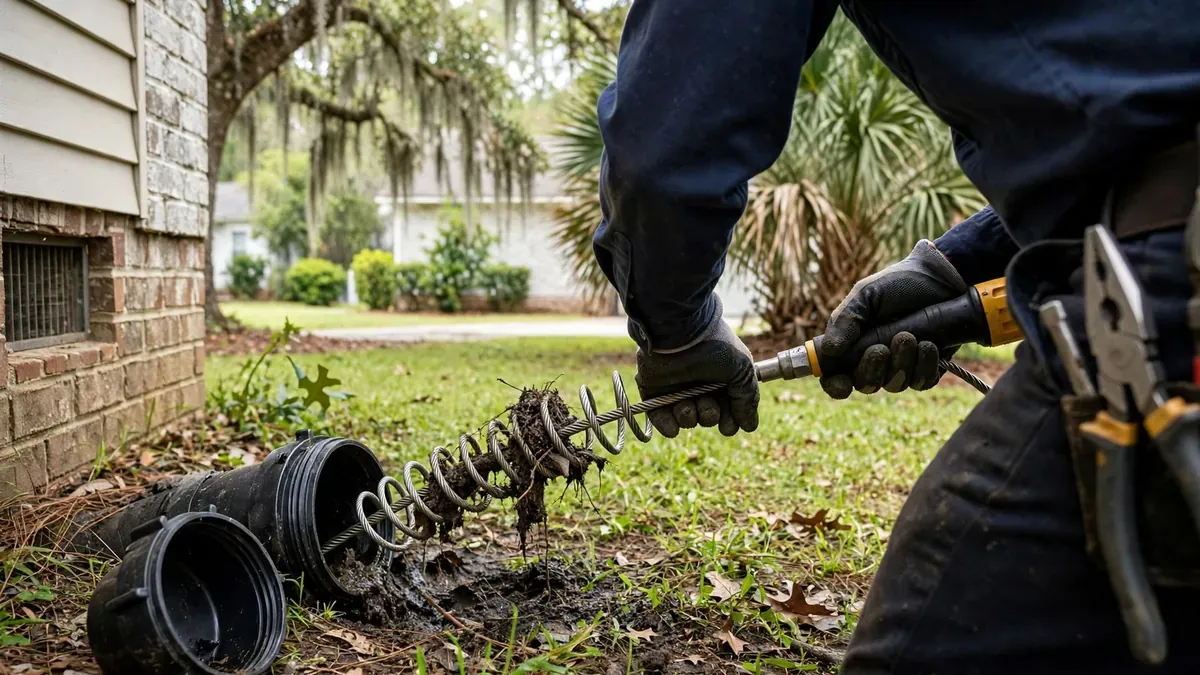
Main line stoppage: how to recognize it.
A main line stoppage shows up as more than one problem. A toilet gurgles when the washer drains, a shower fills when someone flushes and the lowest drain in the house rises first because gravity sends the wastewater there.
One slow drain is rarely the main. Two or three drains on different branches, or any drain at the lowest level, almost always are.
If the problem began after a heavy rain, tell us. High flows in a shared line or infiltration can add water that the lateral cannot carry.
Causes of main line blockages.
What the cable pulls out tells us a lot.
| Cause. | What it looks like. | Does it come back? |
|---|---|---|
| Tree roots. | Hair-like fibres wrapped on the cutter. | Yes, unless the entry point is repaired. |
| Grease and wipes. | Soft mass with fabric or waxy buildup. | Yes, if habits do not change. |
| Scale in cast iron. | Gritty flakes of rust. | Slowly, as the pipe wall degrades. |
| Collapsed or offset pipe. | Cable stops and cannot pass. | Yes, needs repair. |
| Foreign object. | Toys, rags or a broken piece of pipe. | No, once removed. |
Main line backing into the basement? Stop the water and call. Call and we talk it through.
Call (855) 575-2890How we clean a main line.
Find the cleanout.
Most homes have a cleanout in the basement, crawlspace or yard. If there is none, we pull a toilet or open a roof vent.
Cable the line.
We feed a cable with a cutting head to the blockage and work through it until water flows.
Flush and test.
Running water through every fixture shows whether the line is free.
Recommend next steps.
If the cable found roots or a collapse, we suggest a camera inspection. If grease, we suggest a jet.
Why we recommend a camera after cleaning.
Clearing a line fixes today's problem. Seeing the line tells us why it happened. A camera run costs less than a repeat emergency visit, and it gives you video to keep.
If the camera shows a clean, sound pipe, you are done. If it shows a break, root entry or an offset, you can plan the repair rather than wait for the next backup.
Cleanouts, a gift for the next emergency.
A properly placed cleanout lets us reach the main without removing a toilet. If your house lacks one, installing it during a cleaning visit is a good use of the time, because every future visit gets faster and cheaper.
Outdoor cleanouts should have a tight cap and be marked. Do not cover them with mulch or landscaping.
Prevention that works.
Do not flush wipes labelled flushable, paper towels, feminine products or cooking grease. These are the most common solids we pull out of main lines.
Tree roots are a long-term issue. Planting trees away from the line, and scheduling a camera inspection every few years if your yard has mature trees, catches root entry before it becomes a backup.
Main lines in a river city.
Chillicothe is built on a river terrace, and the 1913 flood left a mark on how the city thinks about water. Today's levees protect the city, but high groundwater remains. In saturated ground, roots and silt enter weak joints and sewer laterals can sag.
If your home is outside the city sewer area, for example on a rural road toward Kingston, you may have a septic system. A full tank can mimic a main line blockage, and we will not cable a tank outlet that needs pumping.
What affects sewer line cleaning pricing.
We quote before work starts.
- Access. A cleanout near the main is quick. No cleanout means more time.
- Blockage type. Roots and compacted debris take longer than soft stoppages.
- Equipment. Large cutting heads and a camera add scope.
- After hours.Ask about any call-out charge before you agree to a visit.
Sewer backup damage is often excluded from standard homeowners policies. Ask your insurer whether you have an endorsement, and photograph everything before cleanup.
What to do before we arrive for a sewer backup.
Sewage carries bacteria, so keep contact to a minimum.
- Stop using sinks, tubs, toilets and the washer so no more water enters the line.
- Keep children and pets out of any area where sewage has come up.
- Do not use chemical drain cleaners, which can burn the plumber and the pipe.
- If a basement floor drain is flooding, turn off power to wet areas only from a dry spot.
- Wear gloves and wash well after touching anything the water reached.
Where cleaning ends and repair begins.
Cleaning clears the line without changing it, so no code change is involved. If the camera shows a break, a bellied section or roots through a joint, the fix becomes a repair under the Ohio Plumbing Code, built on the International Plumbing Code (IPC), and the county health district handles inspection under OAC 1301:3-2-04.
Sewer line cleaning questions answered.
.
Whether main line backups can be handled in the evening or on a weekend is confirmed when you call (855) 575-2890, and it is not promised in advance. Describe what is happening and ask what can be arranged. Meanwhile, stop running water into the affected drains.
.
Look in the basement near the foundation wall, in the crawlspace or outside near the house for a capped pipe, usually three or four inches wide. If you cannot find it, tell the person on the phone.
.
If it was a one-time object, no. If it was roots, grease or a damaged pipe, yes unless the cause is fixed.
A camera shows which case you have.
.
If the blockage is in the public main, possibly. If it is in your lateral between the house and the main, it is usually the owner's responsibility. A camera run documents where it is.
.
We clear the line between the house and tank. The tank itself needs a septic specialist.